Red Velvet Dining Room Chairs

Red Velvet Dining Room Chairs

  • Menu
  • Account
  • Setting
  • Home
  • Culver Dining Chair - Crimson Velvet
Download the Spec Card for This Range

Culver Dining Chair - Crimson Velvet

NOW £223.00 Our Price £279.00

Perfect for teaming with one of the three stunning Culver dining tables, our Culver Rustic Oak Dining Chair has been upholstered in a plush crimson velvet and would make a striking addition to any dining area. Available in five gorgeous colourways and upholstered in a luxurious velvet, these stunning chairs offer a blend of luxury and quality which is sure to wow.

This item will be delivered ready-assembled.

More Information
Height 890mm
Width 480mm
Depth 640mm
Colour Red
Please note; we currently only deliver to Isle of Wight addresses. We apologise for any inconvenience.
STANDARD DELIVERY

FREE on orders over £100. £10 on orders under £100

Delivery to a room of your choice. Professional two-man delivery team. Available Monday - Friday.

SPECIAL DELIVERY SERVICE

£39

Delivered to a room of choice. Packaging removed and taken away. Assembly of divan beds and sofas*. Professional two-man delivery team. Available Monday - Friday.

*Items classed as flat-pack/self-assembly do not qualify for this service.

CLICK & COLLECT

FREE

Available 7 days a week. Weekend collections require 2 days notice. Collect from any of our three stores. Once your goods are in stock, we will notify you to arrange collection.

Find out more about our Delivery Options.

Find out about our Cancellations & Returns.

We have a range of payment options available to make beautifully designed furniture accessible to everyone.

Up to 2 Years Interest Free Credit

Spread the cost of your new sofa, bed or mattress with our interest free finance. Our finance options offer flexibility with a variety of contract lengths. Choose from 6, 12, 18 or 24 months. You then simply need to make your agreed fixed monthly payments over your chosen length of contract. The monthly payments are interest free, meaning the price you see today is the price you'll pay.

Buy Now, Pay Later

Order your new furniture today and pay nothing for up to 12 months - no deposit required. The price you see is the price you pay, you simply pay the balance of your furniture by the contracted date with no hidden interest rates.

Deposit Payments

You can pay a 20% deposit at the checkout today and pay the balance when your furniture arrives into our warehouse.

Find out more about our Finance Options

More from this collection

Check items to add to the cart or
free-iow-delivery-gold.png
ISLE OF WIGHT DELIVERY

Free delivery to room of choice on orders over £100.

finance-gold.png
0% INTEREST FINANCE

Spread the cost! Available on purchases over £500.

award-winning-brands-gold.png
AWARD WINNING BRANDS

Discover all the big brand names in one place.

price-match-promise-gold.png
PRICE MATCH PROMISE

Best price guaranteed, with delivery to the IOW.

Red Velvet Dining Room Chairs

Source: https://www.solentbeds.co.uk/culver-dining-chair-crimson-velvet/p8696

Share:

Blue And Gold Dining Chairs

Blue And Gold Dining Chairs

Everything You Need to Know About Blue Light

Photo Courtesy: Marvel Studios/The Walt Disney Studios/IMDb

For beach-goers, experts always recommend a healthy coating of sunscreen to protect the skin from those pesky ultraviolet (UV) rays. But sunlight contains more than just UV light. In fact, it's made up of red, green, yellow, blue and orange light rays, which combine to create "white light" (a.k.a. sunlight). If you haven't sat through a high school chemistry class in a while, no worries. We'll break down the important stuff — without getting too scientific.

As the name suggests, visible light can be seen by the human eye, and each ray reflects a particular color. The color of a given ray depends on said ray's wavelength (see the graphic below) — or the distance between successive crests of a wave. (Side note: This means that objects get their colors through the wavelength of the light that is reflected from them. Trust us — don't think too hard about it. Things get trippy.)

Another important relationship to note is that of wavelengths and energy: The longer the distance between waves, the less energy a ray has to offer. Think of it this way — if the wave crests are farther apart, they're a bit lackadaisical, but if the crests come in rapid succession, there's a frenzy of energy there. All of this means rays on the red end of the visible light spectrum have longer wavelengths and less energy, whereas rays on the blue end have shorter wavelengths and more energy.

UV rays, which aren't on the visible light spectrum, surpass blue light in terms of how much energy they contain. That incredible amount of energy is how those rays are able to create a physical change, like tanning (or burning) one's skin. In moderation ultraviolet radiation can be good for us (think vitamin D!), but, on the other hand, it can also produce some devastating effects (think sunburn and snow blindness!).

How Does Blue Light Impact One's Health?

But what about blue light — these visible rays that are a few notches below harmful UV rays? Well, approximately one-third of all visible light is considered high-energy visible (HEV) blue light. Blue light is literally why the sky appears blue: These rays scatter more easily than other visible rays of light when they strike the atmosphere's air and water molecules — and all that scattering makes the sky that vibrant blue.

Photo Courtesy: Wikimedia Commons

There's no escaping it, especially because daylight is our main source of blue light. But it's not all bad: Experiencing blue light during the daytime helps regulate one's circadian rhythms, makes one more alert, elevates cognitive function, promotes good recall and is even used in light therapy to treat seasonal affective disorder (SAD). However, human-made objects — including LED lights and display screens on flat-screen TVs, computers and smartphones — emit blue light too. Although these devices only emit a fraction of the blue light the sun emits, researchers and doctors have still voiced concerns about patients' excessive screen time in recent years.

Perhaps surprisingly, the human eye is pretty great at protecting the retina from UV rays, but blue light is a different story. Virtually all of it penetrates the light-sensitive retina, causing damage that approximates macular degeneration — a condition that can lead to vision loss.

In addition to potentially harming your eyes over time, blue light can also lead to eye strain. If you've ever ended up with a wicked headache after staring intensely at an Excel spreadsheet for hours, you're probably familiar with that particular discomfort. When we noted how blue light contributes to the sky looking blue, we mentioned that this is so because of how blue light scatters. Well, according to All About Vision, this same scattering of the blue light that emanates from screens makes for "unfocused visual 'noise' [that] reduces contrast and can contribute to digital eye strain."

If you don't suffer from eye strain due to increased exposure to blue light, these inescapable rays may still have adverse effects on your health. Any sort of light — regardless of where it falls on the spectrum — can suppress the human body's ability to release melatonin, the hormone that regulates sleep cycles. However, it's thought that blue light quashes melatonin secretion even more than other hues do. Researchers at Harvard University compared the effects of blue and green light exposure and found that "blue light suppresses melatonin [secretion] for about twice as long as the green light and shifted circadian rhythms by twice as much."

It's a Blue, Blue World

BluTech, a company that manufactures special blue light-filtering lenses, reports that "43% of adults have a job that requires prolonged use of a tablet or computer" — and that's just while said adults are on the clock. Factor in all that time we spend online, texting and marathoning Netflix, and adults spend roughly 12 hours a day looking at screens and taking in blue light. So, how can you mitigate the harmful effects of prolonged exposure to blue light?

Photo Courtesy: @felixgrays/Twitter

Well, these blue light-filtering lenses are becoming all the rage. Although not as ubiquitous as Away suitcases or Blue Apron commercials, you've probably heard commercials for blue light-filtering specs from Felix Gray or Warby Parker on your favorite podcast or radio talk show. Felix Gray glasses, for example, pride themselves on having a blue light-filtering material embedded inside, which the company says will curb eye strain, headaches and sleep disruption.

If you're not into the glasses route, experts recommend taking screen breaks, both at work and at home; keeping screens clean to reduce glare and further eye strain; changing your abrasive white display background to something less bright; blinking more often; and avoiding screens for at least 30 minutes to an hour before bed because screens stimulate your brain. Maybe it's time to trade that fancy blue light-emitting tablet for a Kindle Paperwhite, or, you know, a good old-fashioned book.

Blue And Gold Dining Chairs

Source: https://www.faqtoids.com/health/blue-light-facts?utm_content=params%3Ao%3D740006%26ad%3DdirN%26qo%3DserpIndex

Share:

Gray Wood Dining Chairs

Gray Wood Dining Chairs

What Paint Should I Use for Wood?

Photo Courtesy: eclipse_images/E+/Getty Images

From the cabinets in your kitchen to a piece of furniture to a fun craft, there are plenty of wood items you can paint. And one of the best things about wood is that it accepts a variety of paints well, whether you opt for something that's acrylic or an oil-based formula. Painting wood is an easy way to change its look and give it some new personality, but it's not always clear what paint to use for different projects and applications. Here's what you need to know about the right paint to use for wood.

What's Your Project?

First, it's essential to figure out the nature of your project, meaning you'll need to determine not only what you're painting but also where it's located or going to be used. Are you painting shingles on the exterior of your home? Or are you painting an outdoor deck that'll see a lot of foot traffic? How about kitchen cabinets that people will touch often, or a bathroom shelf that'll be exposed to high humidity from the shower?

Knowing things like whether or not it's going to get wet, how often someone's going to use it or touch it and what overall effect or look you want to achieve are all essential for determining what paint you should use for the project. Wood accepts a very wide range of paints and stains, but each of those can have differing levels of durability and protection. Some paints are better than others in certain situations, and you'll need to know your particular situation before you make your choice.

Paint Types and Formulas

The great thing about wood is that, as long as you apply primer to it in most cases, any type of paint works well on it, depending on what function you need your project to serve. Generally speaking, paints to use on wood are water-based or oil-based. Acrylic and latex are the two most common types of water-based paints, while oil-based paints fall into two categories: synthetic or natural. Each of these is better than others for specific applications.

Latex paint is quick-drying, easy to clean and better for the environment than other types. It's also less likely to discolor over time. However, it's not the most durable choice, as it can scratch and chip easily. It's best for indoor wood items or surfaces that you won't touch or use very often, such as rarely used furniture, storage cabinet doors, stair spindles and picture frames. Latex paint is often the most affordable type.

Acrylic paint is ideal for home exteriors, although you can also use oil-based paint here. If the exterior is made up of different materials, such as stone and wood, you're better off choosing acrylic. Materials like stone and masonry need breathable paint to allow moisture and water vapor to pass through, and oil-based paint prevents this. Acrylic craft paints are also widely available and easy to use and clean up if you're doing a simple DIY craft project using wood.

Synthetic oil paint, which is also called alkyd, is the best choice for applications where you need a lot more durability. Think everyday furniture that'll get used and jostled often, kitchen and bathroom cabinets, interior trims like baseboards and door frames that'll get kicked and touched often, and flooring indoors and out. Oil-based paints are more rigid than flexible, water-based types so they're less likely to chip — even when people are walking on them — and they're also easier to wash clean because of this.

Natural oil paint, called linseed, is best for craft projects on which you want to create a warm, aged patina. It's typically much more expensive than the synthetic variety, which is why it's best for smaller projects.

Prepping for the Project

To help the paint adhere well and to ensure the finish looks its best when everything is dry, it's important to prep your wood to get it ready. If you're painting an exterior surface or item, give everything a thorough wash to make sure there isn't any dirt, dust, moss or algae, all of which can keep the paint from sticking to the surface. If you're painting wood deck furniture, a table or something else for the outdoors that people will touch frequently, it's a wise idea to sand it before painting to give the paint something smooth to adhere to. Splinters and cracks can also keep the finished product from looking its best, and they're uncomfortable to sit on. Let the surface or or item dry out fully before applying the paint, and give it a few days to dry and start curing before you use it. It's best to do outdoor wood-painting projects while the weather is nice.

If you're repainting an interior surface or furniture such as kitchen cabinetry or a dresser, take a look at the existing paint or finish. If the item's current paint isn't chipped, cracked or bubbling, you can usually paint right over it; just sand the wood areas briefly to give the surface more texture for the paint to stick to. If you don't need to remove cabinet paint, it's still a good idea to clean the doors with a heavy-duty solution like TSP to eliminate all traces of grease and grime. If you do need to remove a little bit of paint, such as a few chipped areas, you can sand them down. However, you may need to use paint stripper for items with paint that's very damaged. This is a product that softens the old paint so you can scrape and wipe it all off.

A word of caution here: If your cabinets or other painted home surfaces were last done in the 1970s or earlier, they may contain lead-based paint. If you use a testing kit and determine there's lead in your paint, call the National Lead Information Center or your local health department to find out how to proceed.

More From QuestionsAnswered.net

Gray Wood Dining Chairs

Source: https://www.questionsanswered.net/lifestyle/what-paint-should-i-use-wood?utm_content=params%3Ao%3D740012%26ad%3DdirN%26qo%3DserpIndex

Share:

Dining And Sitting Room Designs

Dining And Sitting Room Designs

  • We earn a commission for products purchased through some links in this article.

  • Open-plan living has become a signature style choice for the modern home, helping make our homes feel more sociable and inclusive. From a home office within an open-plan living room idea to a kitchen-diner that acts as a valuable family room – the layout of our homes needs to be more fluid than ever.

    'We know by now that our homes need to be ready to transform into whatever we need, be that a home gym, classroom or office – often with just a moment's notice' says Rebecca Snowden, interior style advisor at Furniture And Choice. 'Creating these dedicated spaces in our home doesn't have to mean sacrificing style.'

    'Whether it's a big project like adding some sliding doors or a divider wall, or simply laying out your furniture in an intelligent way, there are plenty of ways to create self-contained spaces in the home in a way that works for you.'

    Open-plan living room ideas

    The right open-plan living room idea should be well designed and considered, to be able to utilise the combined space to maximise its full potential. Clever decorating and styling ideas will keep the spaces looking separate but seamless.

    Whether you're house hunting in search of more space or renovating your existing home to create it see our top tips for making the most of an open-plan space, without breaking the bank.

    1. Use paint to define different zones

    Grey living room with yellow painted archway

    Image credit: Future PLC/ Jo Henderson

    Open-plan needn't be devoid of different personalities for different purposes. Opening up a living room and dining area is great to create a more generous space, ideal for busy family life. But it does blur the lines when it comes to lifestyle choices. Simple paint effects on architectural details, such as widened doorframes and arches, helps to gently signify different zones within the open space.

    Creating zones within the larger space helps to give a sense of purpose for a living room end to that of a dining area or a kids playroom. This unimposing way of dividing the living space doesn't defeat the object of making it open – it merely gives more structure to how you use the space.

    2. Reflect a style throughout

    white open plan dingin and living room with shelving

    Image credit: Future PLC

    Create a seamless flow from one living area into the next by way of a cohesive decorating scheme throughout. In this stylish open-plan living room a beautifully blank canvas of brilliant white makes the room feel airy and bright. Symmetry on the shelving in this white living room idea helps to mirror the decorating scheme – almost tricking the eye into thinking it's the same space?!

    Simple accessories are enough to thread two separate rooms together, and are easy enough to chance to suit changing styles and tastes.

    3. Create an open structure with glass doors

    Black living room with arched glass doors leading to open plan dining and kitchen

    Image credit: Future PLC/ Veronica Rodriguez

    While this living room isn't open-plan in technical terms, replacing traditional doors with a unique glass door frame helps the open layout onto the space beyond. The stylish black living room leads out through glass doors immediately into a vast open-plan kitchen and dining area.

    A feat in interior design, using glass in place of hard materials makes the walls disappear – while allowing you to shut off the living room for more intimate use, as and when some 'me time' is needed.

    4. Leave a partition wall standing

    Open plan living room with dividing wall with open fire

    Image credit: Future PLC/ Rachael Smith

    While you may desire the feeling of openness, you might not want to create one vast space that is devoid of structure. If this is the case consider leaving a section of wall still in place, to divide one end of the room to the other.

    Having an element of division allows you to retain a living room layout – not losing a wall to place furniture against or hang wall art for instance. This smart living room space uses the diving wall to situate an open fire solution, meaning both living areas either side of the wall benefit.

    5. Add personality with block painted zones
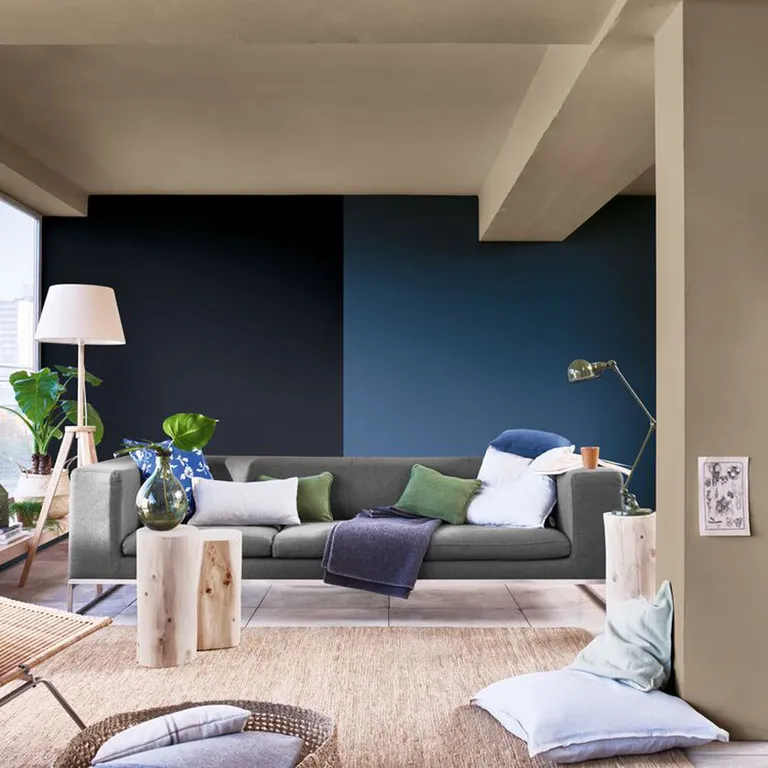
    open-plan living with blue and beige walls

    Image credit: Dulux

    While lounging, eating and working may all take place in one large open-plan area, it doesn't mean you can't zone each area with a different colour. Signify a change of purpose with a splash of colour, with a thoughtful living room paint idea to transform with accent walls. Create a feature wall behind the sofa, perhaps using a cocooning dark shade such as Dulux 'Cobalt Night' (left).

    Paint a block of colour to zone a home office space, within the open-plan layout – working with an engaging colour such as Dulux 'Night Seas'. Using a light neutral on the remaining walls, one such as versatile colour of the year 'Brave Ground' to harmonise and create a seamless flow with accessories and furniture pieces.

    6. Stick to a harmonious decorating scheme

    neutral open plan living room with wooden floor

    Image credit: Future PLC/ Rowland Roques O'Neil

    Create an effortlessly sophisticated and inviting open-plan living room by choosing a neutral living room colour scheme, using the same paint shade and flooring throughout. This soft approach helps to make the space feel more grounded, and adaptable for all uses. Echo tonal accent pieces, such as lilac-grey and charcoal, to add soft colour contrasts without making the space feel overwhelmed.

    7. Choose a sliding door

    Living room with sliding door

    Image credit: Future PLC/ Rachael Smith

    'Sliding doors work well for larger spaces and can really make a difference in a room' explains Rebecca Snowden, interior style advisor at Furniture And Choice. 'While they require more work to incorporate into a space, including sliding doors into your interior design will enable you to separate an open space with style and versatility.'

    'As an example, incorporating a sliding door into your kitchen/dining/living area will provide you with the flexibility to close off one space when you need to. Perhaps for home working, but then seamlessly transform it back into a vibrant space for dining and entertaining when needed.'

    8. Create distinct areas with different textures

    Open-plan kitchen and living room in rustic farmhouse conversion

    Image credit: Polly Eltes

    This barn has been converted into one long open-plan living space. It is light and airy and has a dark blue and green colour scheme running throughout the space. However, different textures and materials have been used to create a distinct divide between the dining area and living space.

    The area surrounding the wood-burning stove, features plush crushed velvet sofas in turquoise and mustard with an aged rug underfoot. In contrast, the dining area is tied together by the natural wood of the table and the wooden bar stools lined up by the kitchen breakfast bar at the far end of the open-plan kitchen design idea.

    9. Thread colourful accessories to unite zones

    Grey open-plan living room with colourful rugs and accessories

    Image credit: Future PLC

    While a grown-up only end of an open-plan living room is good to keep separate from the family space at the other end it can feel disconnected when it comes to the decorating scheme. An easy and effective idea for making an open-plan area feel more connected throughout is to thread a colour palette through, from one end to the other.

    In this smart grey living room idea pops of vibrant colour are welcomed at different levels, via rugs to add colour to floors and on statement furniture pieces for a more impactful approach.

    10. Go green indoors

    Living room with green tree wall mural

    Image credit: Future PLC/ Dominic Blackmore

    Conjure the illusion of an amazing garden landscape idea with a trompe-l'oiel feature wall. Living room wallpaper ideas or a wall mural depicting a lush green forest or meadow can help to welcome the greenery of the garden into your living room, adding to the illusion of extra space.

    Give the space a further botanical feel with luxe green velvet upholstery and an array of houseplants.

    11. Define areas with platforms and partitions
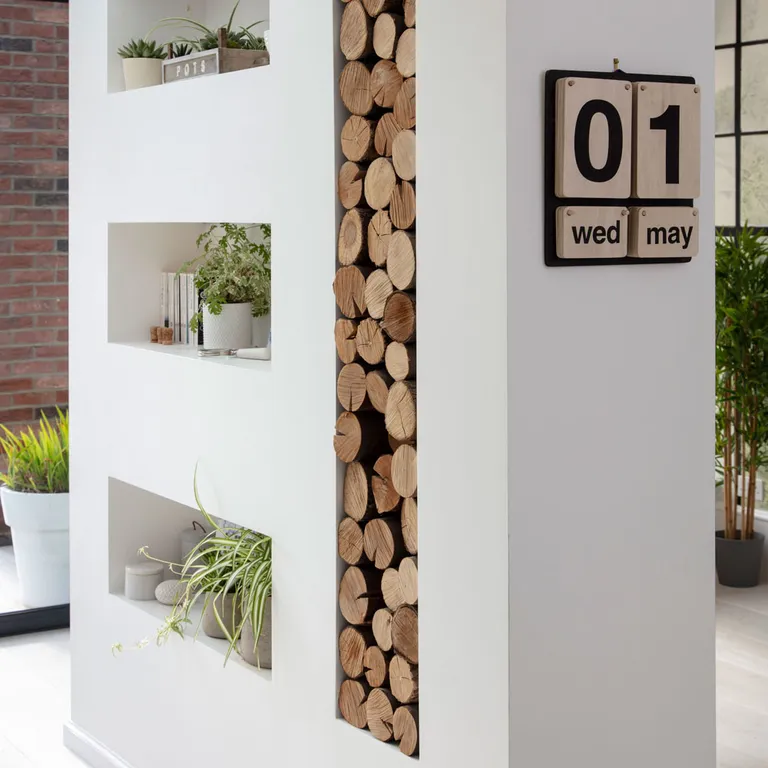
     partition wall with log storage and shelving nooks

    Image credit: Future PLC/ David Giles

    Partially divide an open-plan space with a central column. Within that partition wall add handy alcoves to provide extra storage. This also helps to add a decorative touch to the living room decor.  If you have the layout try raising the floor level in an awkward nook and add storage beneath it.

    This idea is especially handy if you are limited by existing structural foundations that you can't alter, or at least not without huge extension costs.

    12. Open up a period property

    Open-plan living room with period fireplace

    Image credit: Future PLC

    Don't let the age of your property deter you from making modern alterations. Formal front rooms in older properties can often feel dark and enclosed, so knocking through to form an open-plan living room is a popular choice. Removing a wall between rooms offers greater flexibility for the space and enhances the light in townhouses and terraces particularly.

    Before undertaking any work make sure to consult a structural engineer and research any permissions required.

    13. Be smart with colour and shapes
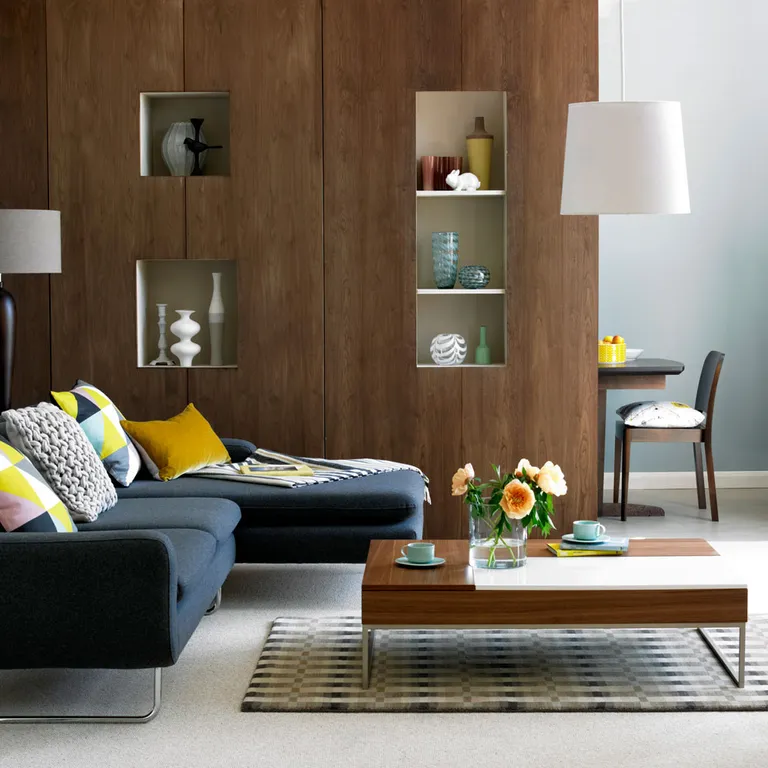
    Living room with wooden feature wall and mid-century furniture

    Image credit: Future PLC/ David Brittain

    Use bold prints and patterns to zone spaces. Use graphic mid-century shapes and strong lines to define areas of an open-plan space. Try varying the living room flooring idea to help further the separation of the spaces. Pick a carpet for the main living area and laminate for adjoining kitchen or hallway spaces. Patterned rugs can add to the look and add more clear zonal definition.

    Go for a walnut finish on a partition wall to add a classic mid-Century vibe.

    14. Make rooms work on another level

    Grey living room with mezzanine level

    Photo credit: Laura Ashley

    Not all homes have horizontal ceilings and single-level floors. Highlight these features by building clever storage and outside-of-the-box zones. Play with the levels. Be savvy with heigh ceilings and create a mezzanine to act as extra living space – such as a home office or guest bedroom. Using a tonal colour palette throughout will help tie the areas together.

    15. Get in the zone

    Open-plan living room with L-shaped sofa and wooden dining table

    Image credit: Future PLC/ Colin Poole

    Openplan living is a great choice as the social aspect is perfect for family interaction. Design allocated zones for lounging, dining and working to keep the room organised. Use soft textures and calm colours to create a welcoming, relaxed vibe while a long-pile rug and pouf are comfortable for little ones. Arrange your room around a large window or French doors to make the most of the natural light.

    16. Let the light in

    Living room with siding doors to patio garden

    Image credit: Future PLC/ David Still

    Think about natural light sources to ensure the room stays bright. Making the most of natural light is a great way to keep a room feeling vibrant and lively and can even help a space feel larger than it actually is. Here, a run of sliding doors leads directly on to a patio area, providing a seamless connection to the outdoors.

    17. Get smart with furniture

    Navy blue living room with stone fireplace

    Image credit: Future PLC/ Lisa Cohen

    Section off the living area of an open-plan space with careful placement of furniture. The benefit of a large, open-plan space is that everyone can spend time together without being on top of each other. Not only that, but as there's direct access to the garden, children can happily head outside to get some fresh air.

    Aside from its spacious layout, this blue living room ideas' winning features are the dramatic walls and beautiful fireplace, which contrast perfectly.

    18. Look to the sky

    Open-plan living room with skylight for light

    Image credit: Future PLC/ Claire Lloyd Davies

    The beauty of open-plan living room is the sense of space, keeping the mood as light and airy as possible aids this effect. A skylight is the ideal solution for single-floor spaces. Spotlights have a clean, modern feel that add to the ambience.

    Here, an elegant fusion of old and new gives a timeless feel to a living room. A painted yellow chair brings a splash of bright colour to this minimal space. A pale wood floor reflects light from the opening to the garden and the hits of strong yellow and bright and cheery touches.

    19. Connect with the garden
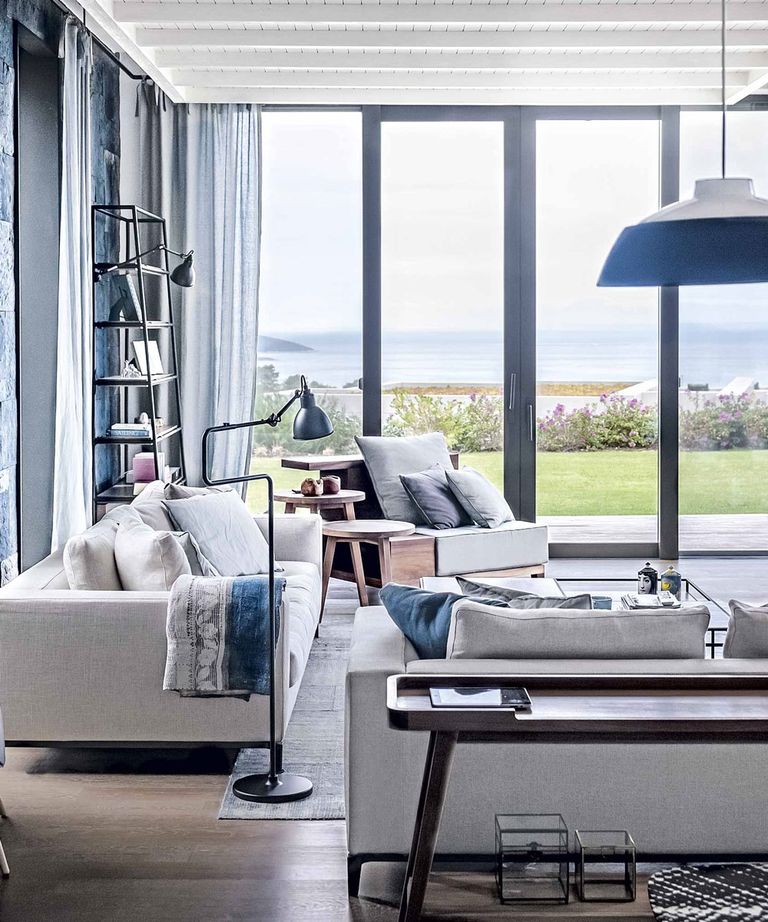
    Blue living room with floor to ceiling bi-fold doors to garden

    Image credit: Future PLC/ James Merrell

    Optimise your open-plan living room by designing it to flow seamlessly out to an adjacent outdoor space. Consider wall-to-wall, floor-to-ceiling patio doors – they will extend your room and optimise light. Make the transition from inside to out seamless by colour-matching internal flooring with external garden decking ideas.

    Choose a decorating palette that complements the garden and position all your furniture to take in the views so it's easy to supervise little ones when they are outside.

    20. Choose an L-shaped sofa

    Open-plan living room with dark green wall and L-Shaped sofa

    Image credit: Future PLC

    Use a corner sofa to define the seating area in a multi-functional open-plan living space, and add a sense of intimacy to a large room. Create a comfy haven and nestle a rug and coffee table into the gap made in front of the sofa to give a friendly, more cosy feel.

    To further enhance the warm mood and create a cosy feel, paint the wall in this area a darker shade than used in the rest of the room. The moody colour behind the sofa helps to enhance it and make it even more inviting.

    21. Make it family-friendly

    cream living room with brown leather sofa and stone chimney breast

    Image credit: Future PLC/ Colin Poole

    Living rooms are meant to be lived in, so make sure your space is somewhere that everyone in the family will enjoy. This cosy open-plan living room combines modern and traditional furniture to create a welcoming, family-friendly space.

    The solid wood dining table is complemented by modern white chairs, which tie in with the white of the large sideboard. The fireplace idea introduces a rustic, tactile edge. While a large wall-hung mirror helps to open out what is a very busy, multifunctional space.

    22. Consider furniture placement

    Open-plan kitchen with living room area with sofas and armchairs

    Image credit: Future PLC/ Nicholas Yarsley

    As one of the most social spaces in the house, your living room needs to look good, work hard and function well. Before you begin any work, take a little time to work out how the space functions for you. Is it a relaxing haven, and entertaining space of family central? A sophisticated neutral palette helps create a comfortable feel in this kitchen living area.

    The trick is to pay attention to balancing the colour scheme and keeping everything in proportion.  An open-plan layout is a fundamental part of modern family schemes and this one incorporates all aspects of living.

    23. Join two rooms with cohesive colour
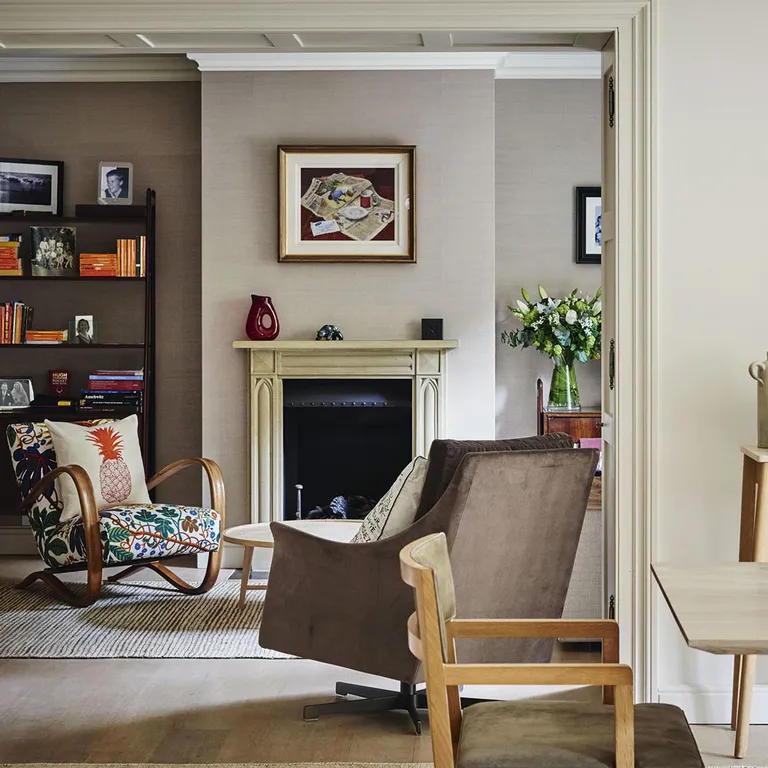
    neutral living room with original fireplace

    Image credit: Future PLC/ Catherine Gratwicke

    Where two rooms are linked but not entirely open, create flow by painting both the same shade. A neutral colour scheme allows the freedom to ring the changes using accessories, giving each room its own personality without the risk of jarring. Turn an open plan space into a functional family living room idea with clear zones for relaxing and dining.

    Soft taupe walls in a matt finish unites the two rooms and forms an elegant base for this traditional neutral decorating scheme. The space has been cleverly divided up with two textural rugs and the positioning of the furniture.

    24. Keep the scheme light and airy

    white living room with dining table in bay window

    Image credit: Future PLC/ Colin Poole

    Open-plan living works especially well in a small home, as by breaking walls, you can make even the tiniest room appear much larger. If you love entertaining, we recommend positioning your dining table and chairs by the window with the most light. Choose furniture that can double up as say a desk, or a bookcase as seen here. And keep colour to a minimum, only highlighting one key piece of furniture.

    25. Keep it tonal
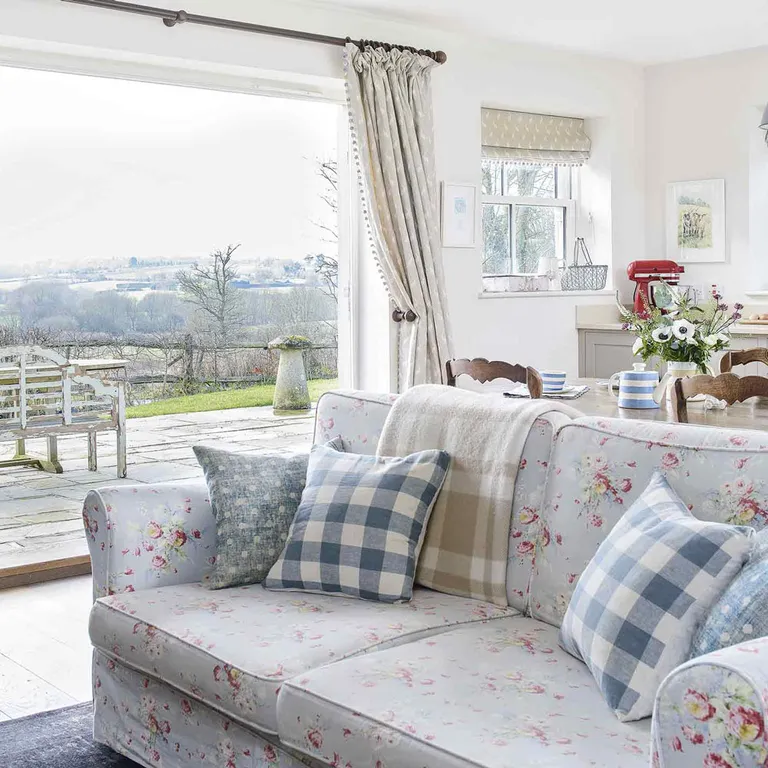
    white living room with dining table and French doors leading to garden

    Image credit: Future PLC/Colin Poole

    Let the outdoors become part of your home with a natural palette. Large windows enhance the light in this open-plan living room. Neutral-toned blinds and curtains with a restful hare motif frame the windows, and pick out the stone-coloured cabinets from the beige and cream kitchen idea. In the foreground an uplifting soft blue sofa creates a year-round summery feel in this welcoming room.

    How do you style an open-plan living room?

    The way you style an open-pan living room helps to determine how you use the space for maximum potential. 'Use furniture to separate multi-functional spaces' advises interior style advisor Rebecca Snowden. 'Nothing adds personality to the home like the furniture you choose, and beyond adding to the style, furniture can be positioned in such a way to stylishly divide rooms into clear sections.'

    'Start by taking measurements of your furniture, then mapping out on paper what you want each area of the space to be used for. Having this plan in place will help you to visualise the finished product and notice where you can use accessories and statement pieces to create clear "zones" within the room.'

    Video Of The Week

    'A bookshelf can be a good way to break up and separate a room in two, just fill the shelving with plenty of books and some trailing houseplants to create a cosy but stylishly-vintage reading nook' suggests Rebecca. ' This style is perfect if you're living in a studio apartment or have an open floor plan, as you can add a bookshelf next to your bed to separate your sleeping area from the rest of your space.'

    Feeling inspired by these open-plan living room ideas?

    Dining And Sitting Room Designs

    Source: https://www.idealhome.co.uk/living-room/living-room-ideas/open-plan-living-room-ideas-88623

    Share:
    banner